
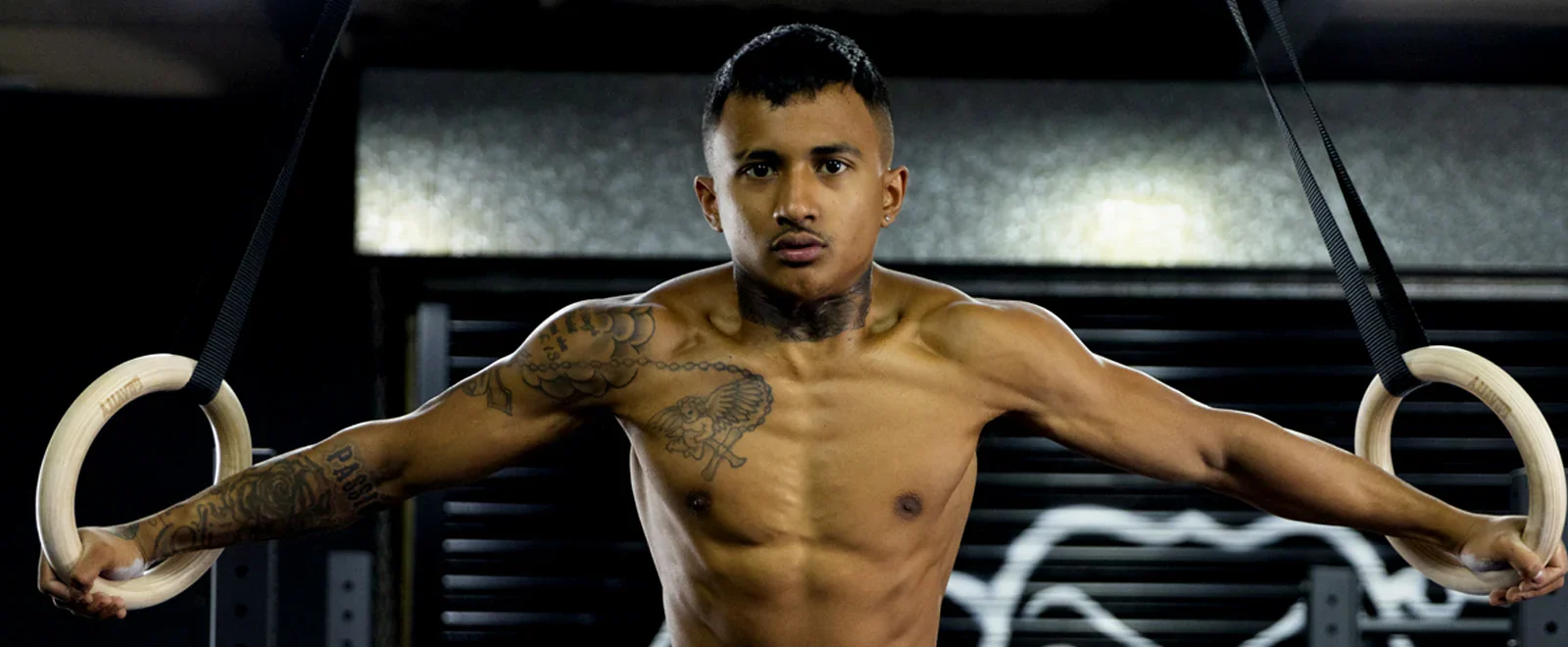

Gymnastic rings represent perhaps the most challenging and rewarding training tool in calisthenics. The instability they provide transforms ordinary exercises into extraordinary muscle-building challenges. Elite gymnasts develop their impressive physiques primarily through ring work.
Understanding how rings enhance calisthenics muscle growth reveals why serious bodyweight practitioners eventually gravitate toward this demanding apparatus.
Why Rings Are Superior for Development
Instability Demands
Fixed bars and parallel bars provide stable platforms. Rings move freely in three dimensions. This instability requires stabilizer muscles to work constantly, dramatically increasing total muscle activation during every exercise.
EMG studies show 15-30% higher muscle activation during ring exercises compared to their stable counterparts. A ring push-up activates more chest, shoulder, and tricep fibers than a floor push-up despite the same movement pattern.
Full Range of Motion
Rings allow natural movement through optimal ranges. Unlike bars that fix your grip position, rings rotate with your body, reducing joint stress while enabling deeper stretches and fuller contractions.
Progressive Difficulty
Ring exercises scale infinitely. From supported ring push-ups to iron cross holds, the progression path provides challenges for decades of development. You never outgrow rings.
Foundation Ring Exercises
Ring Support Hold
Before attempting any ring movement, master the basic support. Hold yourself above the rings with arms straight, rings turned outward 45 degrees. This simple position challenges beginners significantly.
Work toward 60-second holds with stable, controlled rings before progressing.
Ring Push-Ups
Set rings low, perform push-ups with hands on rings. The instability dramatically increases difficulty. Turn rings outward at the top for increased chest activation.
If floor push-ups feel easy but ring push-ups destroy you, welcome to ring training.
Ring Rows
Set rings at hip height, lean back holding the rings, and row yourself up. Adjust difficulty by changing body angle-more horizontal equals harder.
Ring Dips
Significantly harder than parallel bar dips. The stability demands create intense tricep and chest activation. Most people who can do 15 bar dips struggle with 5 ring dips initially.
Ring Pull-Ups
Rings allow natural rotation during pull-ups, reducing shoulder stress while enabling fuller lat contraction. The instability increases overall back activation.
Intermediate Ring Skills
Ring Muscle-Up
The ring muscle-up requires pulling high enough to transition into the dip position-all while managing unstable rings. It’s significantly harder than bar muscle-ups and develops tremendous upper body power.
L-Sit on Rings
Holding an L-sit on rings combines core strength with shoulder stability. The added instability makes an already difficult skill far more challenging.
Ring Archer Push-Ups
One arm presses while the other supports. Ring instability makes this a serious strength and stability challenge.
Bulgarian Ring Dips
At the bottom of the dip, turn rings outward to stretch the chest deeply. This variation creates exceptional chest development but requires significant shoulder strength and flexibility.
Advanced Ring Elements
Back Lever
Hanging inverted with body horizontal, facing upward. Requires extreme shoulder flexibility and strength. The ultimate shoulder and lat developer.
Front Lever
Body horizontal while hanging, facing downward. Primarily a lat and core exercise that creates exceptional back development.
Iron Cross
Arms extended straight to sides while supporting body weight on rings. Perhaps the most iconic gymnastics strength element. Requires years of dedicated training to achieve.
Planche on Rings
Already extremely difficult on floor, planche becomes even harder on unstable rings. Represents the peak of pushing strength development.
Programming Ring Training
Beginners (0-6 months)
- Support holds: 3 x max time
- Ring rows: 4 x 10-15
- Ring push-ups (elevated if needed): 4 x 8-12
- Ring pull-ups: 4 x 5-10
Focus on building stability and mastering basic positions before adding complexity.
Intermediate (6-24 months)
- Ring dips: 4 x 8-12
- Ring muscle-up progressions
- L-sit holds: 3 x max time
- Archer variations
- Tuck lever progressions
Advanced (2+ years)
- Front/back lever progressions
- Iron cross progressions
- Ring planche work
- Complex combinations
Ring Safety
Setup
Rings must be mounted securely to handle dynamic movements. Test with your full weight plus momentum before training. Ceiling-mounted, tree-mounted, or sturdy power rack attachments work well.
Progression
Never skip progressions on rings. The consequences of failure are more severe than on fixed apparatus. A failed ring muscle-up can result in serious falls.
Recovery
Ring training is demanding on joints and connective tissue. Allow adequate recovery between sessions. Most athletes train rings 2-3 times per week, not daily.
Equipment Recommendations
Ring Material: Wood rings provide the best grip. Plastic is more weather-resistant for outdoor use. Metal rings are durable but less comfortable.
Strap Length: Adjustable straps of at least 15 feet allow setup in various locations. Numbering or marks on straps ensures equal height adjustment.
Ring Width: Standard ring inner diameter is 1.1 inches (28mm). This fits most hand sizes comfortably.
Conclusion
Ring training transforms calisthenics development by adding instability that dramatically increases muscle activation. From beginner holds to advanced skills like iron cross and planche, rings provide progressive challenge for a lifetime of training.
Start with foundation exercises (supports, rows, push-ups), progress systematically through skills, and allow adequate recovery. The patience required produces exceptional results-the distinctive physiques of gymnasts prove what ring training can build.