
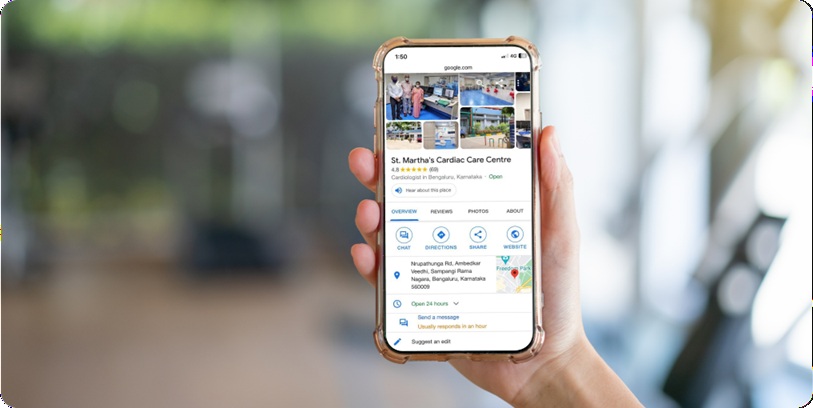

Google Business Profile (formerly Google My Business) is the free business listing service that determines whether a local company appears on Google Maps, in the Map Pack of local search results, and in answers to “near me” queries. For service businesses — plumbers, electricians, attorneys, restaurants, auto repair shops, contractors — it has quietly become the single most important asset on the internet. More phone calls now originate from a Google Business Profile than from any other digital surface, including the business’s own website.
This guide explains, in plain language, what Google Business Profile is, how the major elements function, and where small business owners commonly leave performance on the table.
What Google Business Profile actually is
A Google Business Profile is a structured record about a business, maintained by the business owner, that Google uses to populate three highly visible surfaces:
- The Map Pack — the cluster of three local results that appear at the top of most Google searches with local intent.
- Google Maps — the standalone product where customers search for businesses by location and service.
- Knowledge Panels — the box on the right side of branded search results showing photos, hours, reviews, and contact buttons.
The profile contains business name, address, phone, website, hours, services offered, photos, posts, Q&A, and reviews. Each field contributes to how Google ranks the listing for relevant queries.
Why ranking on Google Business Profile is different from ranking a website
Google Business Profile rankings are determined by three factors Google publishes openly: relevance, distance, and prominence. Distance is fixed (the business is where it is). Relevance is shaped by how completely and accurately the profile describes the services offered. Prominence is the most malleable factor — it reflects review volume, review velocity, citation consistency, and the strength of the business’s broader online presence.
The practical implication is that two businesses on the same block can have very different visibility in the Map Pack purely because one of them keeps the profile current and the other does not.
The most common mistakes
Across thousands of audits, the same gaps repeat:
Incomplete service categories. A roofing company that lists only Roofing Contractor misses the queries that map to Roof Repair, Gutter Installation, Skylight Installation, and so on. Each unselected category is traffic going to a competitor.
No posts or stale posts. The Posts feature is treated as optional by most owners, but Google uses post recency as a freshness signal. Weekly posts visibly correlate with improved Map Pack performance.
Photos that are not refreshed. Profiles with regular new photos see meaningfully higher engagement than static ones. Owner-uploaded photos also outperform stock imagery.
Slow review responses. Google rewards businesses that respond to reviews — both positive and negative — within hours rather than weeks. The response is itself a ranking signal.
Mismatched citations. If the name, address, or phone number on the profile does not match the same fields on the business’s Yelp page, Better Business Bureau profile, or industry directories, Google quietly downgrades the prominence score.
When professional management makes sense
For a single-location service business with ten or fewer employees, an attentive owner can maintain the profile alongside other operational duties — at the cost of two to three hours a week. For multi-location businesses, regulated industries, or owners who do not have those hours, professional management is increasingly common. A specialist providing Google Business Profile management Santa Rosa business owners can rely on will typically handle weekly posts, monthly photo refreshes, review response, citation cleanup, and category optimization for a flat monthly retainer.
For most local service businesses, Google Business Profile is the single highest-leverage marketing asset they own — and it is also the most commonly under-managed. The opportunity is not subtle. Most competitors have left the door open. Walking through it requires the same discipline as any other operational system: complete the profile, keep it fresh, respond to customers, and treat the listing as the storefront it has become.